


A Parisweek: Meeting Nina Childress
My plan for Tuesday was simple: find a quiet café, order something sweet, and spend an hour watching Paris go by.
That plan lasted about twenty minutes.
While walking through a small neighborhood, I noticed a colorful poster attached to a gallery window. It showed a woman surrounded by bright flowers, strange shapes, and dramatic shadows. Underneath the image were only two words: “Look Closer.”
I stepped inside.
The gallery was almost empty. Paintings covered the walls, but there was no loud music, no crowded reception, and no long explanation beside the artwork.
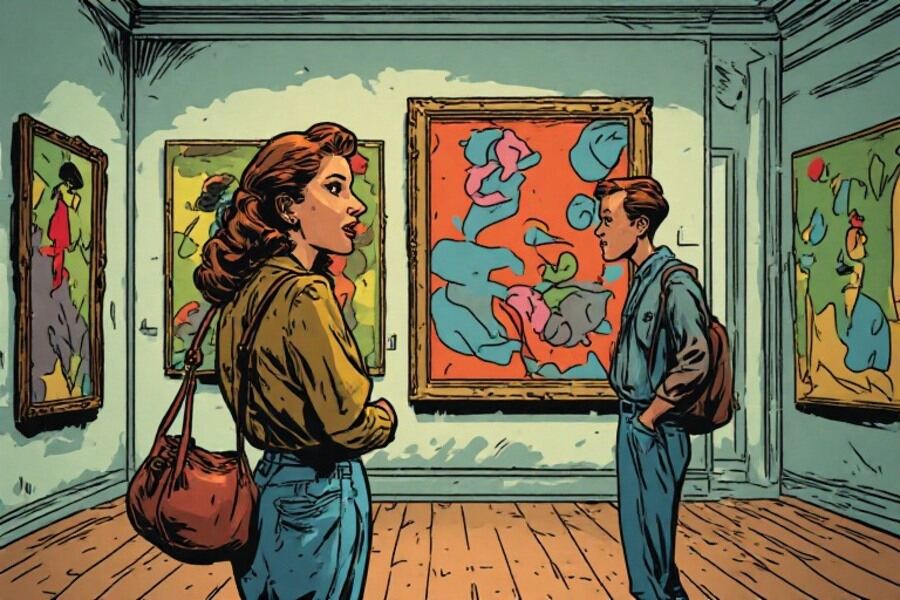
A woman stood near the back of the room, carefully examining one of the paintings.
She turned around and introduced herself as Nina Childress.
I told her that the poster outside had caught my attention.
She smiled and asked what I thought the picture was trying to say.
Can a Painting Tell a Different Story Every Time You Look?
I gave her an answer, but she did not tell me whether I was right.
Instead, she pointed toward another painting and asked me to describe the first thing I noticed.
I mentioned the colors.
She asked what I noticed second.
This time, I noticed a character in the background.
Then she asked what I noticed third.
I discovered a tiny object sitting on a table that I had completely missed at first.
Nina explained that this was part of the fun. A painting did not always need to reveal everything immediately. Sometimes the viewer had to explore it, just as someone explores a new city.
She suggested that we walk through the gallery without reading any descriptions.
We moved from one painting to another. Some images felt playful, others mysterious, and some looked as though they belonged to a dream.
Instead of explaining each painting, Nina asked questions.
Who do you think this person is?
Why is that object there?
What happened five minutes before this scene?
What might happen next?
Suddenly, looking at paintings felt more like inventing stories.
For one particularly colorful picture, I imagined that the central character had missed a train and ended up at a strange party. Nina laughed at the idea and said that every viewer could bring their own imagination into an artwork.
After exploring the gallery, we went outside.
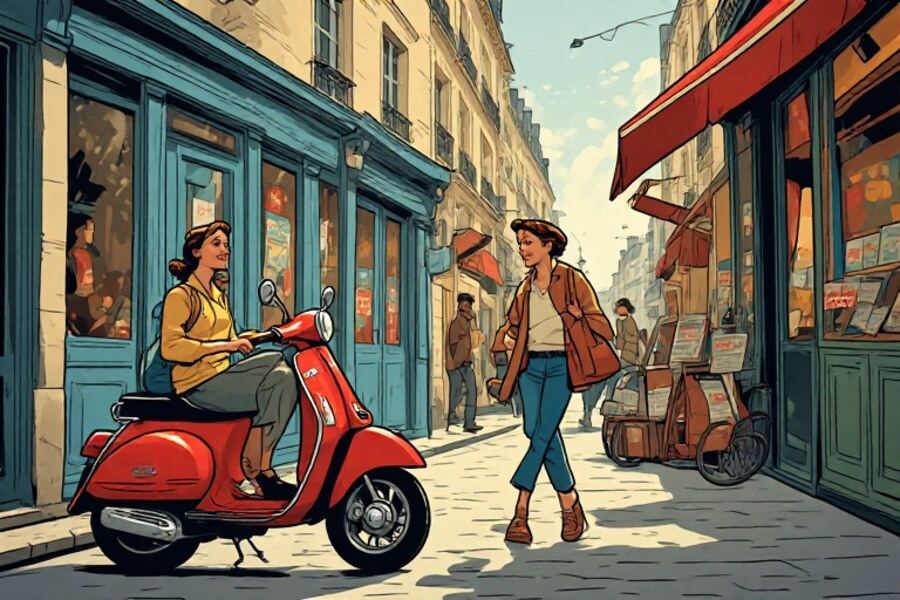
Instead of continuing the conversation about art, Nina suggested something unexpected.
She challenged me to find three interesting pictures in the streets of Paris.
The first was a bright red scooter parked beside a pale blue doorway.
The second was an old movie poster partly hidden behind a newspaper stand.
The third was a reflection of several pedestrians in a café window.
None of them were famous artworks.
Yet when I looked at them carefully, they seemed surprisingly artistic.
Nina explained that artists do not always need to search for extraordinary things. Sometimes an ordinary moment already contains everything needed to inspire an idea.
Before we separated, she gave me the original gallery poster.
On the back, she had written three words:
“Keep looking twice.”
I folded the poster carefully and placed it inside my bag.
Walking back through Paris, I realized that my afternoon had changed completely. I started noticing unusual combinations everywhere: a yellow taxi beside a green doorway, a woman in a red coat passing a blue bicycle, sunlight reflected across a café table.
Nothing had really changed.
Only the way I was looking had changed.
That was the unexpected gift of my meeting with Nina Childress. I had entered the gallery hoping to see interesting paintings, but I left with something much more useful: a reason to pay attention to the colorful, strange, ordinary world around me.
My Parisweek story began with a simple café plan and ended with a gallery poster in my bag. Sometimes the best adventures are not carefully planned. They begin with curiosity, continue with imagination, and leave you seeing familiar places in an entirely new way.