

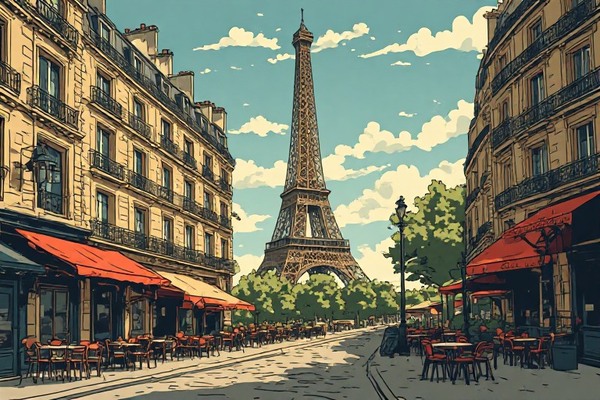
A Parisweek: Henri Matisse
The strangest part of Paris is that you never know what might happen after taking a wrong turn. During my Parisweek adventure, I was trying to find a small bookshop near Montparnasse when I noticed a bright blue envelope tucked underneath a street sign.
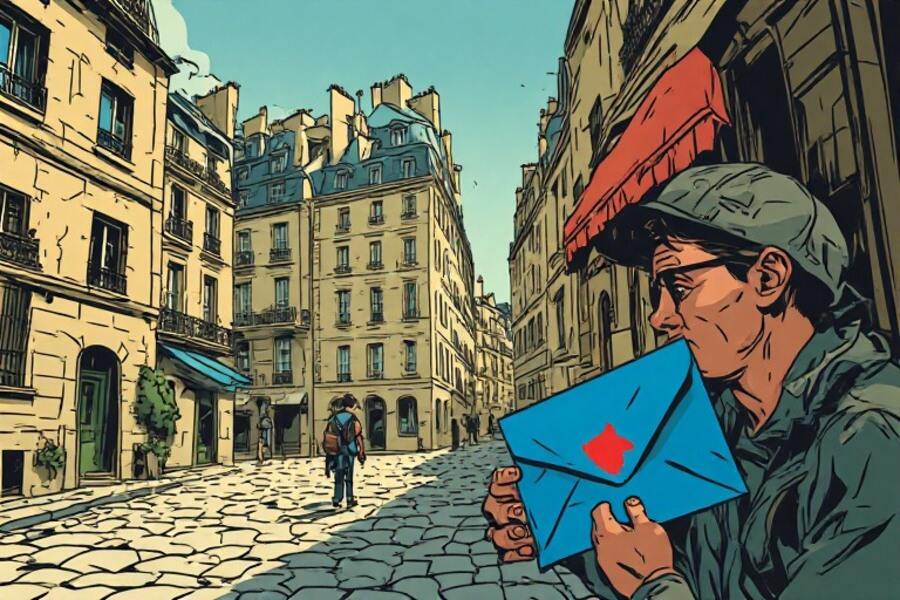
There was no name on it, only a small drawing of a red bird.
Curiosity won, so I opened the envelope. Inside was a short handwritten message inviting me to visit a nearby studio before sunset. The address led me through a quiet courtyard and up a narrow staircase.
At the top, I found a door covered with colorful paper shapes. I knocked twice.
The door opened, and there stood Henri Matisse.
He greeted me calmly, as though receiving mysterious visitors with blue envelopes was part of his daily routine. Instead of asking why I had come, he handed me a pair of scissors and pointed toward a large table covered with colored paper.
“We have work to do,” he said.
I had no idea what he meant.
Why Did Matisse Want Me to Cut Paper?
Matisse explained that he was preparing a special collection of shapes for a private artistic project. He wanted each shape to suggest something without actually showing it directly.
My first attempt was supposed to represent a bird. Unfortunately, it looked more like a strange potato.
Matisse studied it carefully before smiling.
He told me that perhaps it was not a bird at all. Maybe it was simply waiting to become something else.
That was the beginning of a very unusual afternoon.
We spent hours cutting paper. Some pieces were large and dramatic, while others were tiny and curved. Matisse encouraged me to stop thinking about whether something looked “correct.” Instead, he wanted me to think about movement, balance, and feeling.
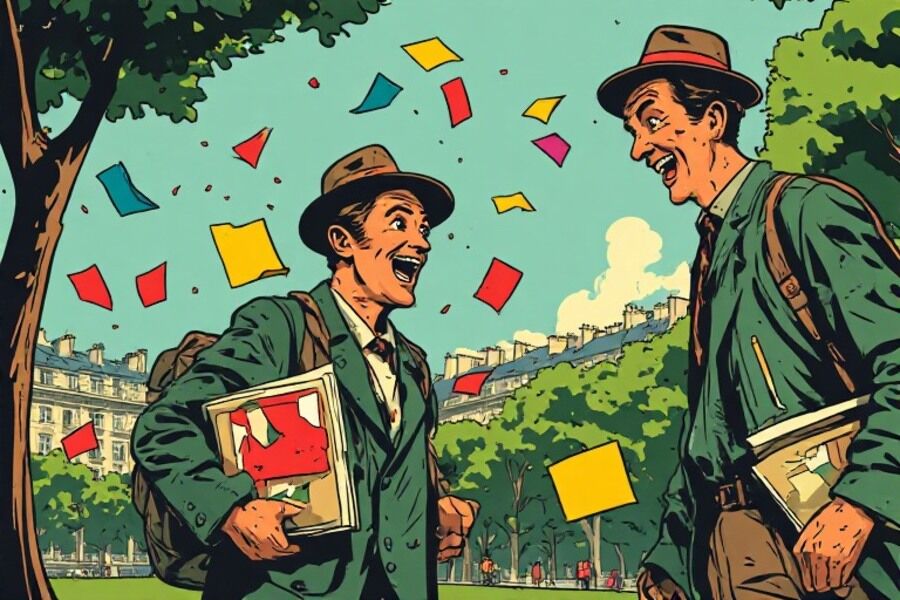
When we had collected enough shapes, he suggested taking them outside.
We walked through the streets of Paris carrying a large folder of colorful paper. People looked at us curiously, especially when the wind caught several pieces and sent them flying down the sidewalk.
One bright yellow shape landed on a passing man’s hat.
He did not notice.
Matisse laughed so hard that he had to stop walking.
We eventually reached a small park. Matisse spread a blanket beneath a tree and arranged the paper shapes across it. The wind moved them gently, creating new patterns every few seconds.
He watched carefully.
Then he said that perhaps the wind was helping us create the artwork.
I had never thought about art that way before.
We spent the next hour rearranging the pieces whenever the breeze moved them. A blue circle became part of a flower. A green shape looked like a leaf. A long orange piece suddenly resembled a dancing figure.
Nothing stayed the same for long.
As the sun began to disappear, Matisse gathered the pieces and placed them back into the folder. He gave me the strange red-bird shape I had made earlier.
I apologized for its unusual appearance.
He smiled and told me that unusual things were often the most interesting.
We returned to the studio just before sunset. The mysterious blue envelope was still on the table where I had found it.
When I turned around to thank Matisse, the room was empty.
There was no sound of footsteps, no closing door, and no explanation.
I walked back down the staircase carrying my paper bird.
Outside, Paris was glowing beneath the evening sky. The city suddenly looked like a giant collage, with colorful windows, dark shadows, bright signs, green trees, and golden lights all fitting together in unexpected ways.
Maybe the mysterious envelope had never existed. Maybe the entire afternoon had been a dream.
But I still had the paper bird in my notebook.
And whenever I looked at it, I remembered Matisse’s simple lesson: sometimes you do not need to know exactly what something is to appreciate what it can become.
My Parisweek adventure had started with a wrong turn and a mysterious envelope, but it ended with something much more valuable a new way of seeing the world.
As the Parisweek journey ends, the little paper bird remains a reminder of an unforgettable afternoon. In Paris, even a wrong turn can lead to inspiration, unexpected laughter, and a story worth carrying home.